
Indian history in the past few centuries has been a story of struggle against foreign invasions and rulers. In 19th century this struggle was against the British occupation of India, which was a pan India movement. It also witnessed Hindu Revivalism, with most of the revolutionaries being deeply religious men. Contempt for foreign rule, western education, thought and way of life was a common principle that inspired them. In Maharashtra, Bal Gangadhar Tilak provided ideas, organisation and leadership. In Bengal Aurobindo Ghosh, Swami Vivekananda and Bankim Chandra provided deep rooted cultural basis to political movements. Tilak turned Shiv Jayanti and Ganpati Utsav gatherings into political events while also inspiring militant dreams through the Bhagawat Gita. His writings and ideas inspired Chapekar brothers to form the Hindu Dharam Sanrakshini Sabha which was responsible for assassination of several hated and exploitative British officers. VD Savarkar swore before Godess Durga to raise the banner of an armed revolution and started Mitra Mela in 1900 at Nasik; while the Abhinav Bharat Society was formed in 1904 at Pune. Aurobindo Ghosh started the news daily ‘KarmYogini’. Anandmath publications inspired Bankim Chander Chatterjee’s call of Mother India and Bande matarm. Swami Vivekananda revised Vedantism. Barinder Ghosh published Yugantar and Bhupender Nath Dutt published Sandhya to ignite the minds of Indians. Miss Kumudini Mitter published the book Sikher Balidan which instilled a spirit of sacrifice.
Dada Bhai Nawroji, Romesh Dutt, GS Inger, GV Joshi, GK Gokhale and DE Wacha were thinkers and writer economists of the time, who proved that India’s colossal poverty and consequent deepening economic depression was the result of the politico-economic structure created by the British. Their system of land holding in India, like that introduced by Lord Cornwallis in 1793 in Bengal and other such systems of land revenue settlements throughout India, threw open the floodgates of imperial, capitalistic and bureaucratic exploitation in the rural areas. This further plunged the agricultural class into the clutches of poverty. People started becoming aware of “Drain theory”, meaning a constant flow of wealth from India to Great Britain in form of excess of imports over exports. Anushilan Samiti was founded in 1901 by P Mitra. Its member Sachinder Nath Sanyal also founded the Young Men’s Association at Banaras in 1908. Lahore conspiracy case (1914-15) claimed the life of Kartar Singh Sarabha. Hardyal, Amir Chand and Dina Nath were activists in Delhi. Hardyal left for the USA in 1911 and started a revolutionary paper ‘Ghadar’ in 1913 at San Francisco. A provisional govt of India was also set up, with Raja Mahender Partap as President and Barkatullah as Prime Minister.
Thus, seeds of revolution were sown by Hindu revivalism in late 19th century as also by various foreign struggles for independence like the American War of Independence, the Irish Independence struggle, Unification of Italy, lives of Mazzini and Garibaldi, the Japanese victory over Russia and Revolution against the Tzar in Russia.
Initially revolutionary acts were isolated and localized, like an attempt on Lord Hardinge’s life in December 1912. However, Jallianwala Bagh massacre and an abrupt calling off of the Non Co operation Movement were watershed movements in Indian freedom struggle. Acts of extreme violence by the British and an extraordinary non-violent restrain and response shown by the Indian leadership, especially disillusioned the youth with Gandhi Ji and his methods.
The Jallianwala Bagh massacre took place on 13 April 1919, when Acting Brigadier-General Reginald Dyer ordered troops of the British Indian Army to fire into a crowd of unarmed Indian civilians killing at least 400 people including men and women and injuring more than 1, 000.
The Chauri Chaura incident took place on February 4, 1922, when a large group of protesters, participating in the Non Co-operation Movement, clashed with police, who opened fire. In retaliation the demonstrators attacked and set fire to the police station, killing all of its occupants. The incident led to the deaths of 3 civilians and 22 policemen. Mahatma Gandhi, who was strictly against violence, halted the Non Co-operation Movement at the national level on 12 February 1922, as a direct result of this incident. Youth of the country was de-motivated because of this sudden decision by Gandhi ji.
Another landmark in the revolutionary struggle came when Hindustan Republican Association was formed in 1924. Its manifesto ‘The Revolutionary’ was released in 1925. The meeting of HRA at Kanpur in 1927 was attended by Bhagat Singh, Chander Shekhar Azad, Sukhdev, Shiv Verma and Vijay Kumar Sinha. The meeting at Feroze Shah Kotla, Delhi on the 8th of September, 1928 was attended by 10 participants from Punjab, UP and Rajasthan and lead to formation of Hindustan Socialist Republican Association for humanity and against imperialism and capitalism. Central committee of HSRA was formed and it was decided to have a Central office at Jhansi. Chander Shekhar Azad was declared commander in chief in absentia. Formation of these organisations was going to have a significant impact on Indian history in coming times.
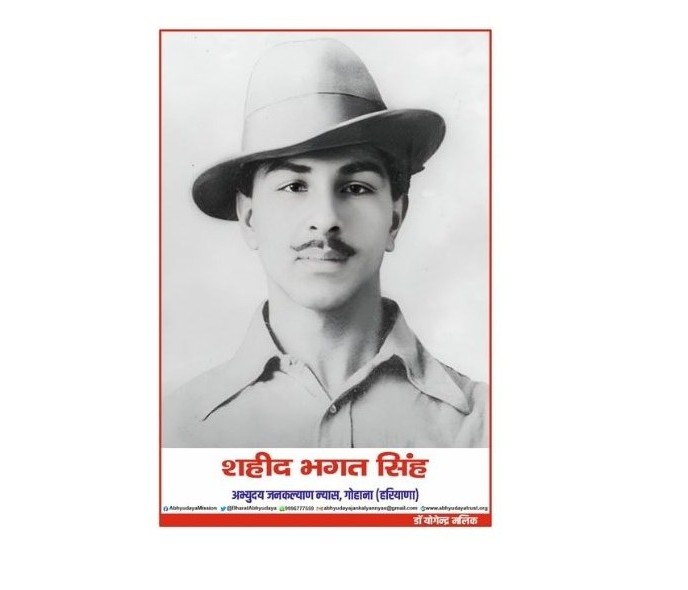
The central figure in revolutionary deeds of that time was Bhagat Singh. Bhagat Singh was born on 28th September, 1907 at Chal no 105 of Lyallpur banga, now in Pakistan. His father Kishan Singh and uncles Ajit Singh and Swarn Singh were revolutionaries. Ajit Singh was founder of the Bharat Mata society along with Lala Lajpat Rai. He was a peasant organiser and was forced to leave India in 1909. He returned after 38 years and died on 15th August 1947 at Dalhousie. Ajit Singh was released from Jail on the day Bhagat Singh was born, however Swarn Singh contracted Tuberculosois in jail and died at the age of 24 years.
Unlike, prominent leaders of those times, Bhagat Singh always harbored revolutionary ideas and believed that an armed struggle was the correct way by which a real freedom could be achieved. A story goes, that a well-known freedom fighter, Mehta Anand Kishor had once met a 4 year old Bhagat Singh. During the discussion, this clarity of thoughts was evident in young child as he said that he would sow rifles in the fields, so that trees would yield weapons, with which the British could be driven away. These beliefs, were further strengthened when at a tender age of 12 years he visited Jalianwalla Bagh, realized the monstrosity of the British and returned home carrying blood soaked soil from the Bagh. His awareness about social happenings and keenness about any the nationalist movement can be gauged from the fact that at the age of just 14 years in 1921, he informed his grandfather, Sardar Arjan Singh (who was a staunch Arya Samaji) about preparations being made by the Railway-men to go on strike. Bhagat Singh, who joined National College Lahore at the age of 15 years, was not only a frontline Freedom Fighter but also a social reformer who mobilized people against caste oppression. He was a philosopher, thinker, learner and avid reader. In fact, he was so well known for his reading habits, that he was not only a regular visitor of Dwaraka Das Library, but also his close associate Shiv Verma never remembered a single occasion wherein he was not carrying books. A look in his jail dairy gives a glimpse into a variety of subjects which he covered, like origin of the state and types of governments, religion, liberty, poverty, hunger, morality, charity, prisoners, capitalism, socialism, leadership, law, life and education. It also covers his viewpoint about the French and Russian revolutions. He also lays down debates about means and ends of violence and ahimsa. It also chronicles his understanding of Arya Samaj. He was an organiser par excellence and formed Naujawan Bharat Sabha in 1926 with Bhagawati Charan Vohra, Dhanwantari, and Ram Krishna (who was it’s first president) and he himself being Secretary at an age of 19 years. The quality which distinguished him from other revolutionaries was his writing skills. Bhagat Singh worked in newspaper ‘Partap’ owned by Ganesh Shankar Vidyarathi and wrote under the pseudonym ‘Balwant’. He also wrote in Prabha (Kanpur), Maharathi (Delhi), Chand (Illahabad) and Kirti (Gurmukhi).
His notable writings are his statement before the Sessions Court- ‘To make the deaf hear’, Message to Punjab Students conference, On the slogan- “Long live Revolution”, Regarding Suicide, Letter to father, Letter to BK Dutt, Letter to Jaidev Gupta, Introduction to dreamland, To young Political Leaders, Why I an Atheist, No hanging, please shoot us and Letter to second Lahore conspiracy convicts. These writings must be read not only by Indians but also by westerners. Mr Medilton, the presiding officer of the Delhi sessions court during the trial of Assembly Bomb Case had admitted his intellectual acumen.
Apart from writing on social issues, he also participated in serving people affected in floods and also taught as a Head Master in School.
In the chain of events that led to full realisation of Bhagat Singh’s revolutionary spirit, martyrdom of Lala Lajpat Rai forms the most important link. At the beginning of 1928, the British had formulated Simon Commision, this Commision didn’t have any Indian representation. The Congress Party decided to boycott the Commission at their session at Madras in 1927. When the Commission landed in February 1928, there were mass protests, hartals and black flag demonstrations all over the country. People were chanting the slogan, ‘Simon Go Back!’ In Lahore, Lala Lajpat Rai, who was leading the demonstration against the Simon Commission, was brutally lathi-charged on 3rd Feb 1928. He died later that year due to injuries sustained on 17 November 1928. This brutal act of inhumanity shook entire nation, so much so that Basanti Devi, widow of CR Das, cried in anguish: “I quake with shame and disgrace…..Does the youth and manhood of the country still exists? Does it feel the burning shame and disgrace of it? A woman of the land demands clear answer to it.”
On 8th and 9th December 1928, a meeting was organised by HRSA revolutionaries at Mozang house Lahore to avenge Lalaji’s death. Subsequently on 17th December 1928, Saunders was killed to avenge Lala Lajpat Rai by Rajguru, Bhagat Singh and Chander Shekhar Azad. It was a huge boost to the psyche of country.
This revolutionary fervour further peaked the very next year, when HRSA decided to bomb the Central Assembly against Public Safety Bill and Trade Dispute Bill. Initially the central committee had decided to send Jaidev Kapoor and BK Dutt to throw bombs but on Sukhdev’s friendly exhortation, Bhagat Singh accompanied BK Dutt. Finally, on 18th April, 1929 the Assembly was bombed. Bhagat Singh and BK Dutt did not make any attempt to escape and raised slogans –“Long Live Revolution” and “down with imperialism”. They were arrested and the infamous trial of the Assembly bomb case began on 7th May, 1929.
The arrest and trial of Bhagat Singh however could not stop the wagon-wheel of revolution and an attempt was made on 23rd December 1929 to bomb the Viceregal special train with Lord Irwin on it, by Yashpal, Bhagawati Charan Vohra and Inderpal at Purana Quilla, Delhi.
Judgement in the Assembly Bomb case was pronounced on 13th June 1929 and they were given the sentence of Transportation for life. However, in light of new facts which emerged due to the statements of approvers, trial for Lahore Conspiracy subsequently began on 11th July 1929. Judgement of judicial hanging was pronounced on 7th October 1930 for Bhagat Singh, Rajguru and Sukhdev which was executed on 23rd March,1931.
Major blow to the revolutionary movement came when, Chander Shekhar Azad, who was betrayed by his companion Virbhadra Tiwari was martyred on 27th February 1931 during a meeting with Sukhdeo Raj at Alfred Park, Allahabad.
Bhagat Singh was a master tactician and used his jail time and court trial for propagation of ideology. He declined any representation by lawyers. The British, petrified of his growing influence, passed an ordinance, under which a tribunal was setup, which could conduct the trial in absence of the accused. This was unprecented and thus proving painted the entire trial as a judicial farce. Undaunted by this one-sided trial, he wrote many letters to drive home his points to the public. Later he and his associates went on a hunger strike in jail which culiminated into matrydom of Jatinder Das on the 63rd day, 7th May, 1929.
The Letter Bhagat Singh wrote to his father after news of mercy petition reached him gives us and understanding of his character integrity, courage and grit. I am reproducing it as it is-
Oct. 4, 1930
My Dear Father,
I was astounded to learn that you had submitted a petition to the members of the Special Tribunal in connection with my defence. This intelligence proved to be too severe a blow to be borne with equanimity. It has upset the whole equilibrium of my mind. I have not been able to understand how you could think it proper to submit such a petition at this stage and in these circumstances. Inspite of all the sentiments and feelings of a father, I don't think you were at all entitled to make such a move on my behalf without even consulting me. You know that in the political field my views have always differed with those of yours. I have always been acting independently without having cared for your approval or disapproval.
I hope you can recall to yourself that since the very beginning you have been trying to convince me to fight my case very seriously and to defend myself properly. But you also know that I was always opposed to it. I never had any desire to defend myself and never did I seriously think about it. Whether it was a mere vague ideology or that I had certain arguments to justify my position, is a different question and that cannot be discussed here.
You know that we have been pursuing a definite policy in this trial. Every action of mine ought to have been consistent with that policy, my principle and my programme. At present the circumstances are altogether different, but had the situation been otherwise, even then I would have been the last man to offer defence. I had only one idea before me throughout the trial, i.e. to show complete indifference towards the trial inspite of serious nature of the charges against us. I have always been of opinion that all the political workers should be indifferent and should never bother about the legal fight in the law courts and should boldly bear the heaviest possible sentences inflicted upon them. They may defend themselves but always from purely political considerations and never from a personal point of view. Our policy in this trial has always been consistent with this principle; whether we were successful in that or not is not for me to judge. We have always been doing our duty quite disinterestedly.
In the statement accompanying the text of Lahore Conspiracy Case Ordinance the Viceroy had stated that the accused in this case were trying to bring both law and justice into contempt. The situation afforded us an opportunity to show to the public whether we are trying to bring law into contempt or whether others were doing so. People might disagree with us on this point. You might be one of them. But that never meant that such moves should be made on my behalf without my consent or even my knowledge. My life is not so precious, at least to me, as you may probably think it to be. It is not at all worth buying at the cost of my principles. There are other comrades of mine whose case is as serious as that of mine. We had adopted a common policy and we shall stand to the last, no matter how dearly we have to pay individually for it.
Father, I am quite perplexed. I fear I might overlook the ordinary principle of etiquette and my language may become a little but harsh while criticizing or rather censoring this move on your part. Let me be candid. I feel as though I have been stabbed at the back. Had any other person done it, I would have considered it to be nothing short o treachery. But in your case, let me say that it has been a weakness - a weakness of the worst type.
This was the time where everybody's mettle was being tested. Let me say, father, you have failed. I know you are as sincere a patriot as one can be. I know you are as sincere a patriot as one can be. I know you have devoted your life to the cause of Indian independence, but why, at this moment, have you displayed such a weakness? I cannot understand.
In the end, I would like to inform you and my other friends and all the people interested in my case, that I have not approved of your move. I am still not at all in favour of offering any defence. Even if the court had accepted that petition submitted by some of my co-accused regarding defence, etc., I would have not defended myself. My applications submitted to the Tribunal regarding my interview during the hunger strike, were misinterpreted and it was published in the press that I was going to offer defence, though in reality I was never willing to offer any defence. I still hold the same opinion as before. My friends in the Borstal Jail will be taking it as a treachery and betrayal on my part. I shall not even get an opportunity to clear my position before them.
I want that public should know all the details about this complication, and, therefore, I request you to publish this letter.
Your Loving Son
Bhagat Singh
Bhagat Singh was as free from hate as he was from fear, proved by his words of appreciation for the Judicial Magistrate despite of his regular torture by police in jail. Forgiveness is trait of great men and he possessed it.
The revolutionary movement in Indian freedom struggle was infused with some unique characteristics due to the entry of Bhagat Singh. Invitations and meetings with revolutionaries from all over India gave the movement a pan India character. Revolutionaries developed their own methods of resistance taking cue from other successful experiments of the time. Discussions and debates on unambigous vision of free India were initiated in revolutionary circles. His own family was staunch Arya Samaji and most of the revolutionaries were deeply religious men. His personal religious beliefs as articulated through his writings never came into way of his largehearted and broadminded way of life and ideals.
He was hanged on 23rd march 1931 at 7.30PM at Lahore Jail. He embraced martyrdom with a smile on his face and in company of his associates. Their bodies were clandestinely taken out of jail and burnt on the banks of river Sutlej.
He said –“Bhagat Singh dead will be more dangerous to the British enslavers than Bhagat Singh alive. After I am hanged, the fragrance of my revolutionary ideas will permeate the atmosphere of this beautiful land of ours. It will intoxicate the youth and make him mad for freedom and revolution, and that, will bring doom of British imperialists nearer. This is my firm conviction.”
He became symbol of Indian pride as Subhash C Bose said- “Bhagat Singh had become symbol of the new awakening among the youth…”
Jawahar Lal Nehru wrote- “Bhagat Singh did not become popular because of his act of terrorism but because he seemed to vindicate, for the moment, the honour of Lala Lajpat Rai, and through him of the nation. He became a symbol; the act was forgotten, the symbol remained, and within a few months each town and village of the Punjab, and to a lesser extent in the rest of northern India, resounded with his name."
His deed and his death aroused national consciousness. His heroic sacrifice aroused political consciousness. 23rd March, 1931 became day of reckoning in Indian history.
Book List:
P.S: I am thankful to Dr Dev Desai and Dr Viraj Nevrekar for editing the article and making it presentable. The content is taken from the books mentioned in book list.